Key Verses on Being Intimately Known
- Psalm 139:1–4“O Lord, You have searched me and You know me. You know when I sit and when I rise; You perceive my thoughts from afar. You discern my going out and my lying down; You are familiar with all my ways. Before a word is on my tongue You know it completely, O Lord.”
- Psalm 139:5–6“You hem me in behind and before, and you lay Your hand upon me. Such knowledge is too wonderful for me, too lofty for me to attain.”
- Psalm 139:13–14“For You Created my inmost being; You knit me together in my mother’s womb. I praise You because I am fearfully and wonderfully made; Your works are wonderful, I know that full well.”
- 1 Corinthians 13:12“For now we see only a reflection as in a mirror; then we shall see face to face. Now I know in part; then I shall know fully, even as I am fully known.”
What This Means
- Complete Transparency: God knows your daily routines, your private habits, your unspoken thoughts, and your deepest motivations before you even form the words.
- Awe Over Fear: Rather than producing terror or exposure, this divine intimacy is meant to bring deep security—realizing that you are fully understood and still unconditionally cherished by your Creator.
And we pray:
Dear God, thank You for this day and thank You so much for sending Your Son to carry what I could never carry on my own. Your Word in Isaiah 53:4-5 says, “Surely He has borne our griefs and carried our sorrows; yet we esteemed Him stricken, smitten by God, and afflicted. But He was wounded for our transgressions, He was bruised for our iniquities; the chastisement for our peace was upon Him, and by His stripes we are healed and made whole.” Father, whatever I’m carrying right now, whether it is loneliness, grief, or anxiety, remind me that You never sent it to punish me. Jesus knows what it feels like to be rejected and left alone, so there’s nothing I’m carrying that He doesn’t understand. Let me trust You in the middle of the waiting, believing there’s real healing for my body, my heart, and my soul. In Jesus’ Name I pray, Amen.
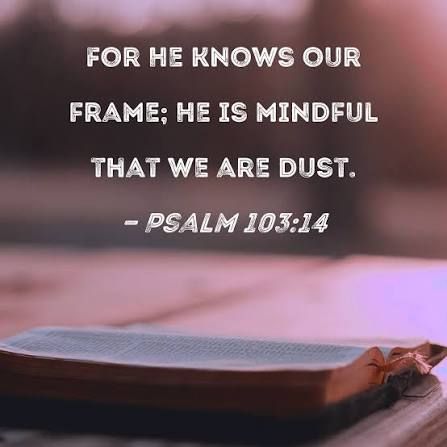
Psalm 103:14 states, “For He knows our frame; He remembers that we are dust,” teaching that God shows deep compassion because He intimately understands human frailty and mortality. Rather than holding humanity to an impossible standard of perfection, God tempers His expectations with mercy because He is the Creator Who formed human beings from the earth.
Core Meaning
- Intimate Creator Knowledge. The Hebrew word for “frame” (yetser) connects directly to a potter shaping clay. It signifies that God understands every physical, emotional, and spiritual limit of human design because He crafted it.
- Acknowledgment of Mortality. Remembering that humans are “dust” echoes the creation account and highlights human vulnerability. In the surrounding verses (Psalm 103:15–16), human life is compared to grass and wildflowers that quickly wither when the wind blows.
- Active Compassion. In biblical Hebrew, God “remembering” is never mere mental recall. It means acting on that knowledge with active grace, restraint, and tenderness.
Key Teachings
- Weakness Draws God Closer. People often hide from God out of shame over their exhaustion, doubts, or failures. This verse teaches that God’s complete awareness of human weakness actually motivates His pity and love rather than His anger.
- Fatherly Patience. Immediately following verse 13 (“As a father shows compassion to his children”), verse 14 explains why God is so patient. A good parent does not expect a toddler to carry an adult’s burden, and God likewise understands what humans can and cannot bear.
- Permission to Be Human. Believers are encouraged to accept their finite limits instead of striving for self-sufficiency. Recognizing personal fragility invites reliance on God’s everlasting strength and covenant Love.
Related Biblical References
- Genesis 2:7. “Then the LORD God formed the man of dust from the ground…” This is the foundational text that Psalm 103:14 directly echoes.
- Genesis 3:19. “…for out of it you were taken; for you are dust, and to dust you shall return.” This passage reinforces the theme of human mortality after the Fall.
- Isaiah 64:8. “Yet, O LORD, you are our Father; we are the clay, and you are our potter; we are all the work of your hand.” This mirrors both the fatherly imagery of Psalm 103:13 and the “forming” imagery of verse 14.
- Psalm 78:38–39. “Yet he, being compassionate, atoned for their iniquity… He remembered that they were but flesh, a wind that passes and comes not again.” This offers a nearly identical theological parallel regarding God’s mercy toward fragile humans.
- 2 Corinthians 4:7. “But we have this treasure in jars of clay, to show that the surpassing power belongs to God and not to us.” The New Testament continues the motif of fragile earthen vessels holding divine grace.


Leave a Reply