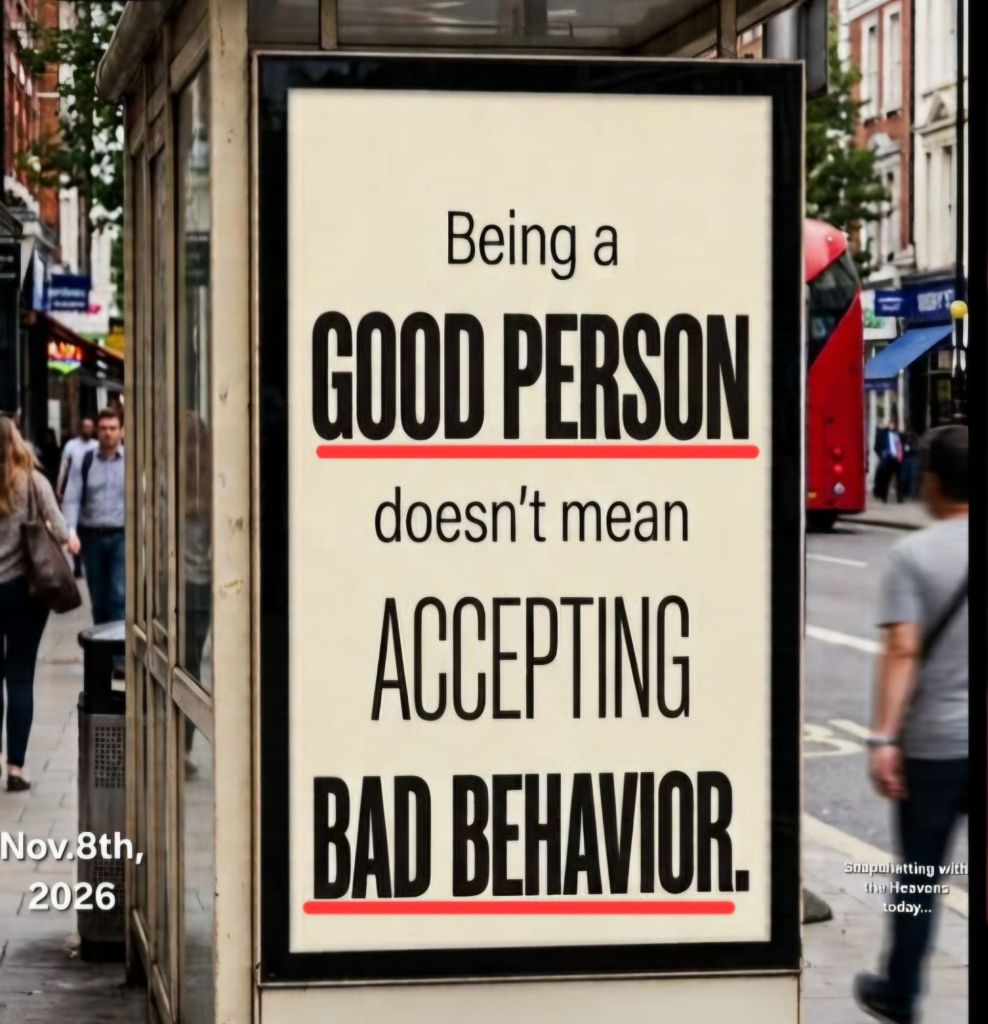
A WHISPER FROM HEAVEN!
📌 A good person accepting bad behavior; is there truly any/much sense here?
The Bible does not teach that a good person should passively accept or enable bad behavior.
Instead, it distinguishes between grace, forgiveness, and love on one hand, and boundaries, accountability, and rejecting sin on the other.
1. Forgiveness Does Not Equal Enabling
- No passive endorsement: Scripture warns against excusing, supporting, or participating in harmful and sinful behavior. Forgiveness is an internal release of bitterness or a desire for personal vengeance, whereas accepting or enabling ongoing harm is viewed as unwise.
- Establishing boundaries: Biblical guidance allows—and often instructs—believers to set clear boundaries, protect their hearts, and separate from destructive patterns if an offender refuses to repent or change (Proverbs 4:23 -“Above all else, guard your heart, for everything you do flows from it.“. Matthew 18:15–17 outlines Jesus’ instructions for handling conflict, sin, or disputes among fellow believers, establishing a step-by-step process aimed at restoration rather than punishment.
- The 4-Step Process
Step 1: Private Conversation (Verse 15) Go directly to the person privately to discuss the fault.
If they listen and repent, the relationship is restored and the matter ends.
Step 2: Involve Witnesses (Verse 16)If they refuse to listen, take one or two others along.
This follows biblical principles (like Deuteronomy 19:15) so that the situation is verified by objective witnesses. [1, 2]
Step 3: Tell the Church (Verse 17a)If they still refuse to listen, bring the matter before the local church or community of believers.
Step 4: Treat as an Outsider (Verse 17b) If they reject the church’s counsel, treat them as a “pagan or a tax collector” (an outsider to spiritual fellowship).
The goal remains calling them to repentance and keeping the community accountable.
2. Grace and Accountability Go Together
- Loving correction: Rather than silently accepting bad behavior, the biblical model encourages speaking the truth in love and holding others accountable (Matthew 18:15).
- Not repaying evil with evil: Christians are commanded not to retaliate or sink to the level of those who mistreat them (Romans 12:14, 1 Peter 3:9), however, refusing to retaliate is not the same as approving of the bad behavior. Jesus and the Apostles frequently confronted hypocrisy, injustice, and sin directly.
3. The Human Context
- All fall short: According to the Bible, no human being is morally perfect or a purely “good person” in a flawless sense; rather, all people struggle with sin and require grace.
- Patience vs. Participation: While scripture calls for patience, long-suffering, and praying for difficult or hostile people (Matthew 5:44), it does not require anyone to subject themselves indefinitely to abuse, corruption, or unchecked evil without wisdom and protection.
By human standard, goodness is measured by the lateral kindness and support we give one another. It attracts people’s applause and affection and so many of us are often tempted to become accomplices to generate a crowd even at the expense of truth, justice and integrity… let us tame our ambitions to become a celebrity, politician or a leader!
Remember this always: Jesus – The Word of God, in human form lived here on Earth and served people! The people He created! And died for us; taking our sin on His sinless body, being whipped to shreds! Bleeding for you and I! Dragging the cross He was hung on! Falling from pain and exhaustion!
Jesus falls under the weight of the cross during His walk to Golgotha due to severe physical exhaustion, blood loss, and trauma from prior beatings.
Key Details of Jesus’s Falls
- The Stations of the Cross: In Christian tradition and the Stations of the Cross, Jesus is traditionally remembered as falling three times on the way to His crucifixion.
- Causes of Exhaustion: Prior to carrying the heavy wooden crossbeam (patibulum), Jesus endured sleeplessness in the Garden of Gethsemane (where He experienced hematidrosis, or sweating blood), facial beatings by guards, and a brutal scourging with a lead-tipped whip (flagrum) that tore His skin and muscles.
- The Meaning: The falls emphasize Christ’s full humanity—showing that He experienced genuine physical weakness, pain, and fatigue. In Christian teaching, each time He fell, He rose again to continue carrying the cross, symbolizing perseverance and redemption.
“Why do you call Me good?” Jesus answered. “No one is good—except God alone.”
LK. 18:19.
Reflection: No one is good except God!
Righteousness is alignment with God’s will and purpose, it helps us to reject immorality at all costs – that obviously goes beyond natural or physical goodness… Let’s amend our priorities!
The truth? A person may be rated “good” by man but never by God until he/she passes the moral and spiritual test of life; which is only possible by seeking to please God, not man… A message for us!
May God help us, Amen.🙏🔥
And we pray:
Father, Your will be done in and with my life, I pray in Jesus’ Name, Amen.


Leave a Reply